Findings of EACL 2026
Language Model-Driven Data Pruning Enables Efficient Active Learning
Lahore University of Management Sciences
ActivePrune is a plug-and-play data pruning strategy that reduces the computational cost of active learning on large unlabeled pools without compromising selection quality.
Findings of the Association for Computational Linguistics


Introduction
Active learning reduces annotation costs by selecting only the most informative examples for labeling. However, its acquisition functions must repeatedly evaluate every example in the unlabeled pool. At large scales, this makes active learning itself computationally prohibitive.
Large language models can identify high-quality training examples, but scoring an entire pool with an LLM simply replaces one expensive operation with another. We introduce ActivePrune, a fast two-stage filter that runs before the acquisition function and preserves the examples most useful for active learning.
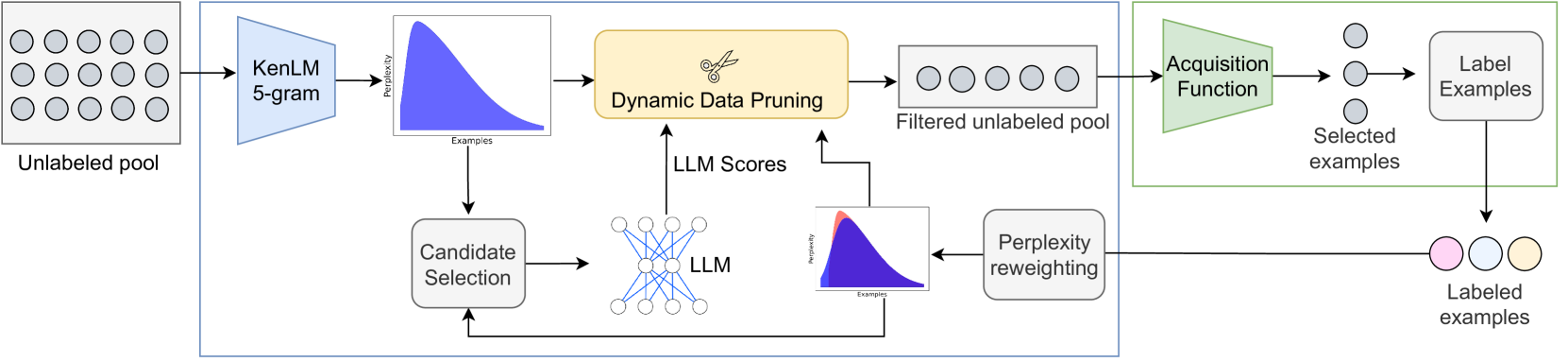
How ActivePrune works
1. Fast perplexity scoring
A KenLM 5-gram language model computes inexpensive perplexity scores across the entire unlabeled pool. This first pass quickly narrows the search space while requiring only modest compute.
2. Targeted quality assessment
A quantized 2B-parameter language model evaluates data quality for the smaller candidate set. ActivePrune combines these scores to retain high-quality and informative instances before acquisition.
3. Diversity-aware reweighting
After each active learning round, a perplexity reweighting procedure uses the newly labeled examples to prioritize underrepresented regions of the pool in subsequent rounds.
Here, A measures the average perplexity distance from the newly labeled set L, and β controls the strength of the adjustment. Instances farther from recently labeled examples receive lower reweighted perplexity and are therefore more likely to be selected by bottom-k sampling.
Evaluation
We evaluate ActivePrune across four NLP tasks, four datasets, and four active learning strategies. This setup tests whether the method generalizes beyond a single task or acquisition function.
| Task | Dataset | Evaluation |
|---|---|---|
| Translation | IT domain | SacreBLEU |
| Sentiment analysis | IMDB | Accuracy |
| Topic classification | AG News | Accuracy |
| Summarization | PubMed | ROUGE |
Results
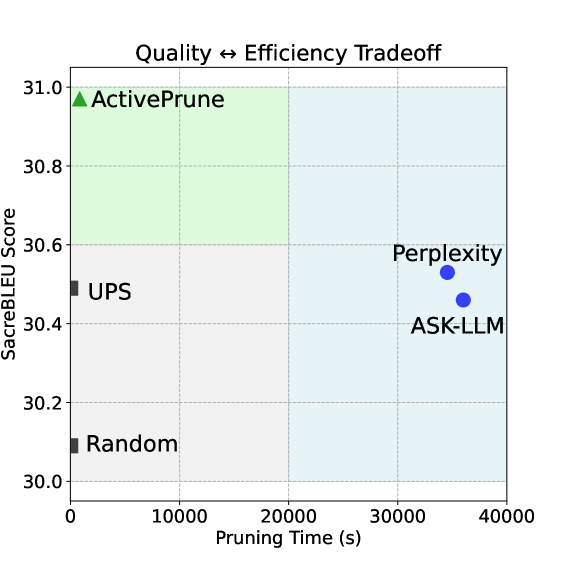
ActivePrune consistently improves the selection quality versus efficiency tradeoff. Compared with direct LLM score-based pruning, it is 97% more computationally efficient and reduces end-to-end active learning time by up to 74%.
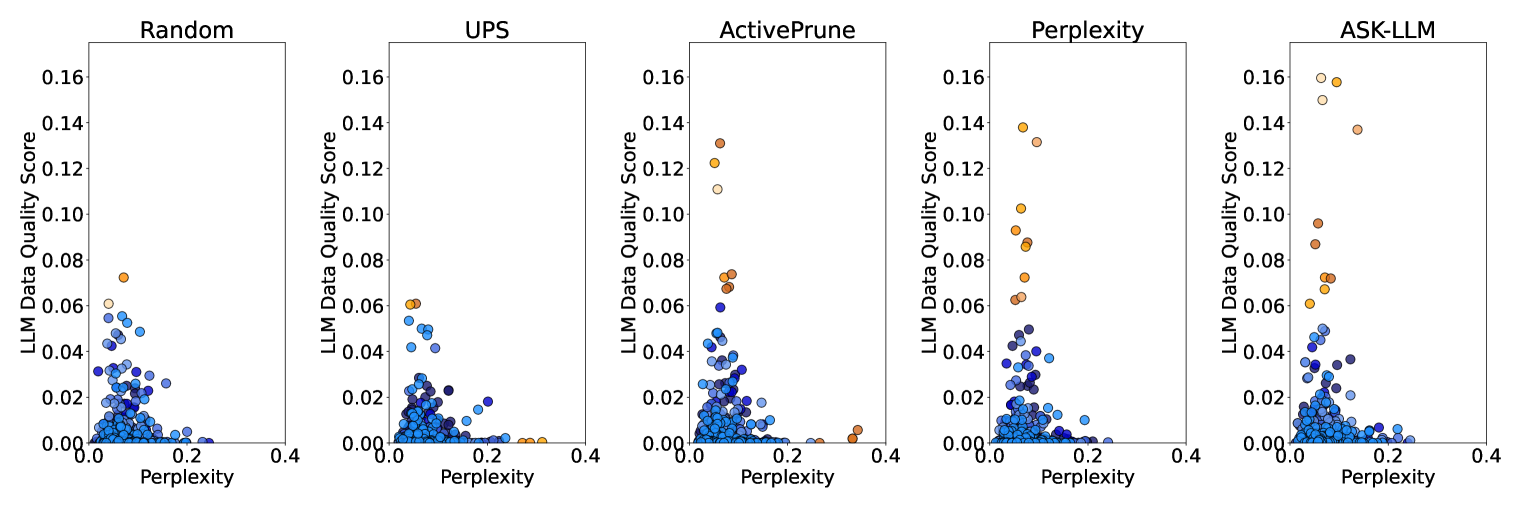
What does ActivePrune select?
ActivePrune balances examples with high LLM quality scores and examples with high perplexity. The reweighting process also changes selection over time, bringing forward useful regions that have been underrepresented in earlier labeling rounds.
Conclusion
ActivePrune makes active learning more practical on large datasets by pruning the pool before expensive acquisition. Its staged language-model scoring and diversity-aware reweighting preserve selection quality while substantially reducing computation.
Citation
@inproceedings{azeemi-etal-2026-language,
  title     = {Language Model-Driven Data Pruning
               Enables Efficient Active Learning},
  author    = {Azeemi, Abdul Hameed and Qazi, Ihsan Ayyub
               and Raza, Agha Ali},
  booktitle = {Findings of EACL},
  year      = {2026}
}