Findings of EMNLP 2023
Data Pruning for Efficient Model Pruning in Neural Machine Translation
Lahore University of Management Sciences
Training-data pruning makes iterative movement pruning faster. Hard-to-learn translation examples preserve model quality while reducing convergence steps and fine-pruning time.
Findings of the Association for Computational Linguistics


Introduction
Model pruning lowers memory use and inference cost after deployment, but producing a sparse model is expensive. Movement pruning repeatedly trains and prunes a model until it reaches the target sparsity, making the fine-pruning procedure itself a substantial computational burden.
We combine data pruning with movement pruning for neural machine translation. By identifying the training examples that matter most, we can fine-prune on a smaller dataset, converge in fewer steps, and retain translation quality.
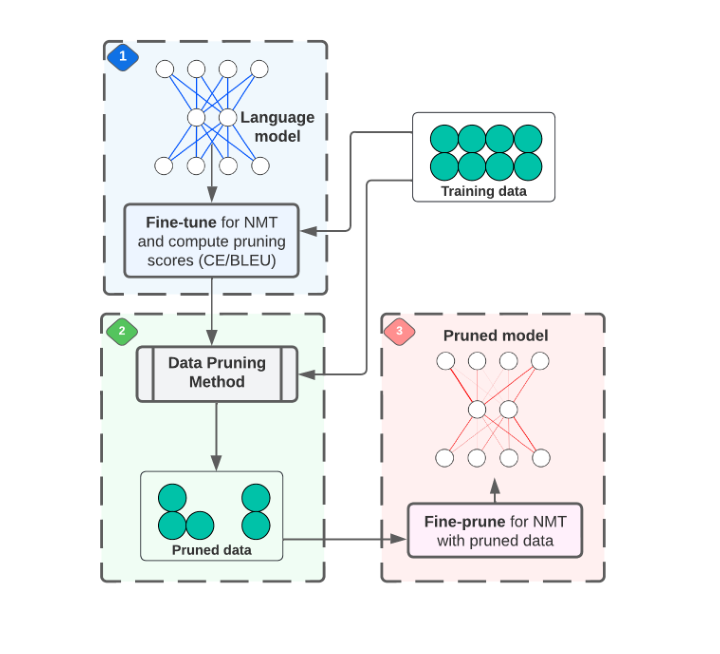
Prune the data before fine-pruning the model
The pipeline separates one-time data scoring from repeated fine-pruning runs, allowing the initial scoring cost to be amortized across sparsity levels and architectures.
1. Score the complete dataset
An unpruned pretrained language model is fine-tuned on the full parallel corpus. Per-example training cross-entropy is recorded as the data-pruning score.
2. Construct training subsets
Examples are ranked and selected with Top-K, Bottom-K, stratified, or random sampling. Top-K retains the highest-loss, hardest-to-learn sentence pairs.
3. Fine-prune on less data
A fresh model is trained on the selected subset while movement pruning gradually removes attention heads and dense-layer parameters to the target sparsity.
4. Reuse the ranking
The same data ranking can support multiple pruning runs. The paper also tests rankings computed with T5 when fine-pruning BART-base.
Evaluation
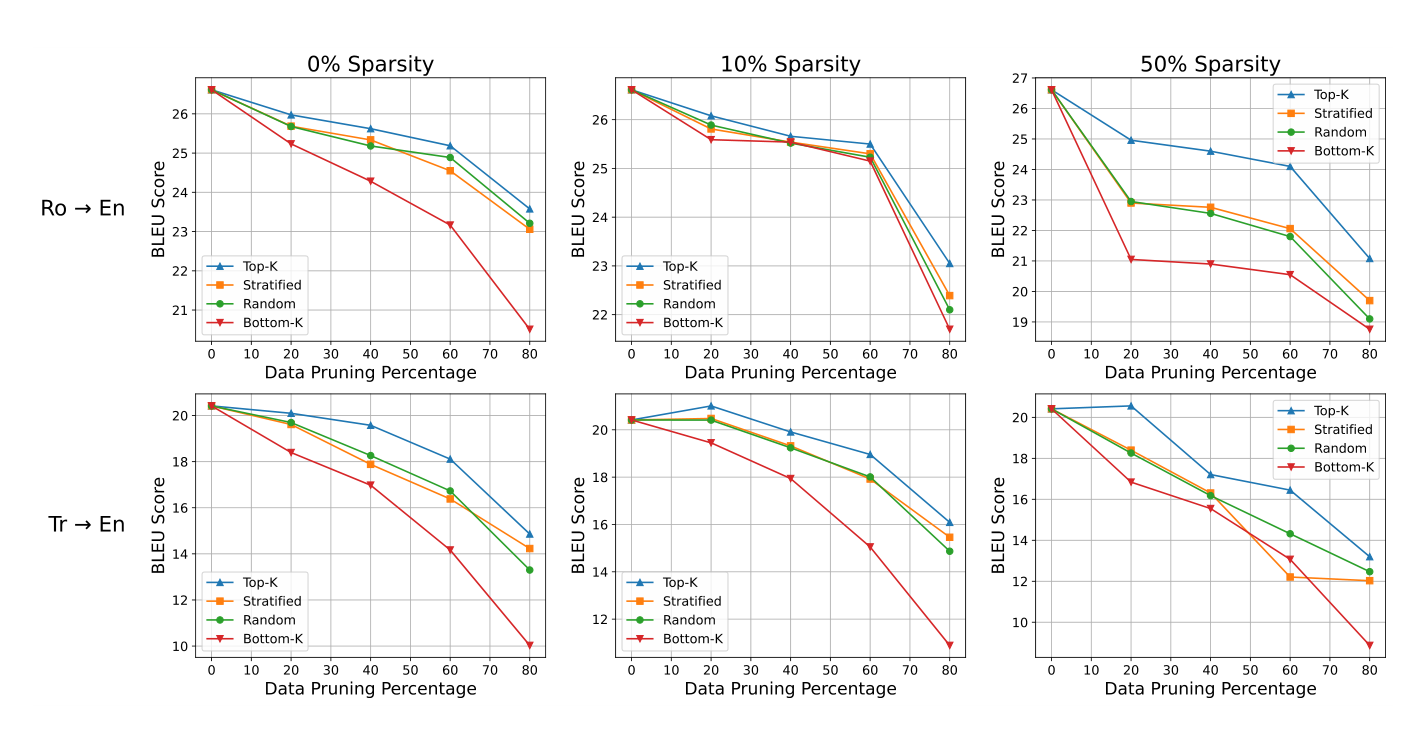
Experiments use WMT16 Romanian–English and Turkish–English with T5-small. Models are pruned to 10% and 50% sparsity while the training dataset is pruned by 20%, 40%, 60%, or 80%. Translation quality is measured with BLEU.
Turkish–English provides a particularly challenging setting because Turkish morphology produces a large vocabulary and the source and target languages use different word orders.
| Dataset | Training pairs | Dev | Test |
|---|---|---|---|
| WMT16 En–Ro | 610,320 | 1,999 | 1,999 |
| WMT16 En–Tr | 205,756 | 1,001 | 3,000 |
Results
Top-K selection consistently preserves the strongest BLEU as pruning becomes more aggressive, particularly at higher model sparsity. Retaining hard-to-learn examples is more effective than easy-example, random, or distribution-stratified selection.
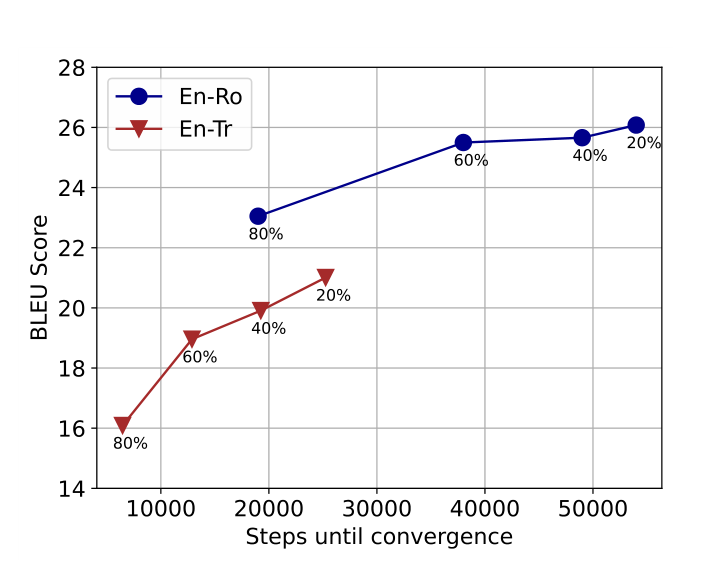
For Romanian–English at 10% model sparsity, moving from 20% to 60% data pruning reduces convergence from 54,000 to 38,000 steps—a 29.6% reduction—with only a 2.22% relative BLEU decrease. On Turkish–English, fine-pruning with 40% of the data is 48.9% faster than using 80%.
Quality versus convergence
Data pruning exposes an explicit compute–quality frontier. Practitioners can choose a subset size from available training compute or work backward from an acceptable BLEU range. The one-time ranking cost is then amortized over subsequent fine-pruning runs.
Conclusion
Data efficiency and model efficiency can be optimized together. Cross-entropy-based Top-K selection reduces movement-pruning cost while retaining difficult translation examples, and its rankings transfer across pruning configurations and model architectures.
Citation
@inproceedings{azeemi-etal-2023-data,
  title     = {Data Pruning for Efficient Model Pruning
               in Neural Machine Translation},
  author    = {Azeemi, Abdul Hameed and Qazi, Ihsan
               and Raza, Agha},
  booktitle = {Findings of EMNLP},
  pages     = {236--246},
  year      = {2023}
}