Interspeech 2023
Self-Supervised Dataset Pruning for Efficient Training in Audio Anti-spoofing
Lahore University of Management Sciences
A label-free pruning method uses wav2vec 2.0 representations and clustering to retain informative audio, outperforming supervised pruning metrics while reducing selection computation by 91%.
24th Annual Conference of the International Speech Communication Association

Introduction
Neural audio anti-spoofing systems are increasingly expensive to train. Existing data-pruning metrics can reduce dataset size, but they depend on labels and an initial model-training run to determine which examples are important.
We propose a self-supervised alternative that selects informative audio directly from pretrained speech representations. It removes both label dependence and the preliminary anti-spoofing training step from the pruning pipeline.
Pruning from pretrained speech representations
The method treats distance in self-supervised representation space as a proxy for example difficulty and informativeness.
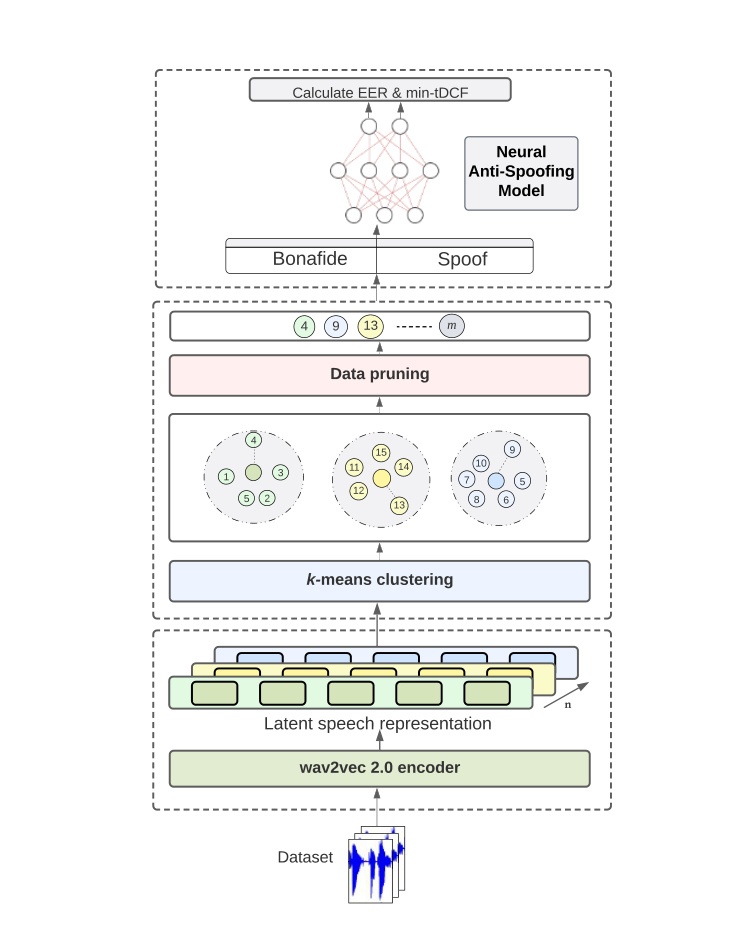
1. Encode every utterance
Each 16 kHz audio sample is passed through a 95M-parameter wav2vec2-base model. Its contextual representations are flattened into a fixed-size embedding.
2. Cluster the representation space
K-means groups examples with similar latent speech characteristics. This reveals structure without using bonafide or spoof labels.
3. Score by centroid distance
Cosine distance to the nearest cluster centroid estimates example difficulty. Farther, less prototypical examples receive higher importance scores.
4. Retain informative audio
Within each cluster, the highest-distance fraction is kept. RawNet2 or AASIST-L is then trained on the resulting compact subset.
Evaluation
We evaluate on the ASVspoof 2019 Logical Access dataset using RawNet2 and AASIST-L. Equal error rate and minimum tandem detection cost are averaged over three runs at pruning fractions from 0% to 90%.
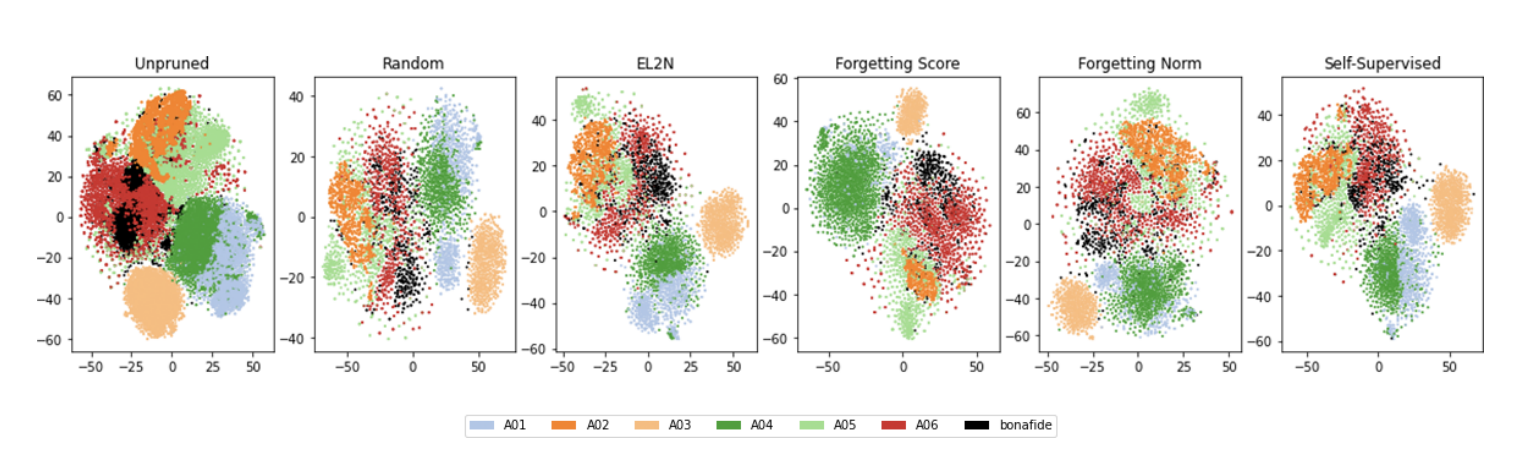
The comparison includes Random, EL2N, Forgetting Score, and Forgetting Norm. Unlike these supervised metrics, self-supervised pruning does not require labels or an initial anti-spoofing training run.
| Model at 90% pruning | Self-supervised | Best baseline |
|---|---|---|
| RawNet2 EER / min-tDCF | 12.84 / 0.34 | 15.29 / 0.41 |
| AASIST-L EER / min-tDCF | 10.30 / 0.27 | 13.74 / 0.34 |
Results
At the most aggressive setting—90% of training data removed—the self-supervised method achieves the best EER and min-tDCF on both architectures. For RawNet2, it lowers EER from 19.09 to 12.84 and min-tDCF from 0.56 to 0.34 compared with the second-best scoring metric.
Selection uses only 8.51% of the computation required by Forgetting Norm on RawNet2, corresponding to approximately 91% lower pruning time.
Sensitivity to the number of clusters
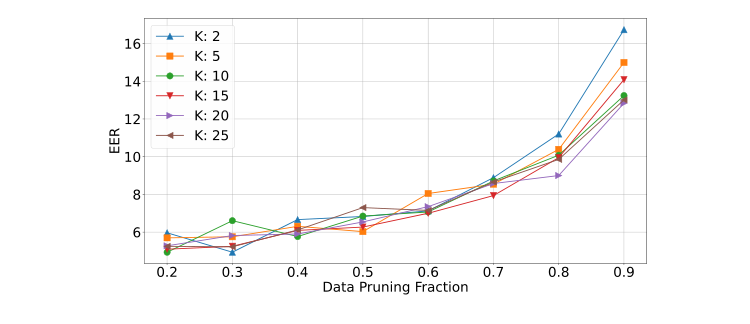
Across moderate pruning levels, performance is stable over a broad range of k-means cluster counts. Cluster choice becomes more influential only when very little data remains, where preserving every informative subpopulation is harder.
Conclusion
Pretrained speech representations provide a fast, label-free signal for dataset pruning. By keeping examples that are distinctive within the latent space, the method improves anti-spoofing performance under severe data constraints while avoiding an expensive scoring-model training run.
Citation
@inproceedings{azeemi23_interspeech,
  title     = {Self-Supervised Dataset Pruning for Efficient
               Training in Audio Anti-spoofing},
  author    = {Azeemi, Abdul Hameed and Qazi, Ihsan Ayyub
               and Raza, Agha Ali},
  booktitle = {Interspeech},
  pages     = {2773--2777},
  year      = {2023}
}