Interspeech 2022
Dataset Pruning for Resource-constrained Spoofed Audio Detection
Lahore University of Management Sciences
Forgetting Norm ranks audio examples with a stable, fine-grained training signal, enabling anti-spoofing models to learn from substantially smaller datasets with less performance loss.
23rd Annual Conference of the International Speech Communication Association


Introduction
Modern neural anti-spoofing systems rely on large training datasets, which makes them difficult to develop in compute-constrained settings. Dataset pruning can retain only the most informative audio, but existing scoring methods are either coarse or unstable.
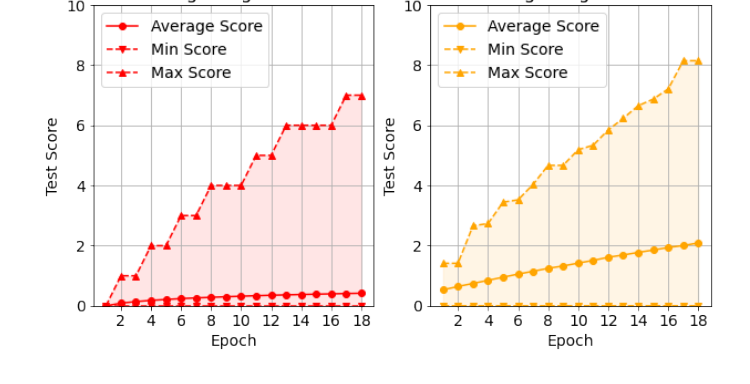
We introduce Forgetting Norm, a continuous metric that tracks increases in an example's normed prediction error over training. It combines the temporal information of forgetting events with enough granularity to distinguish examples that receive the same discrete forgetting count.
A fine-grained view of forgetting
Forgetting Norm extends conventional forgetting events by measuring how strongly an example moves toward being forgotten, not only whether a discrete event occurred.
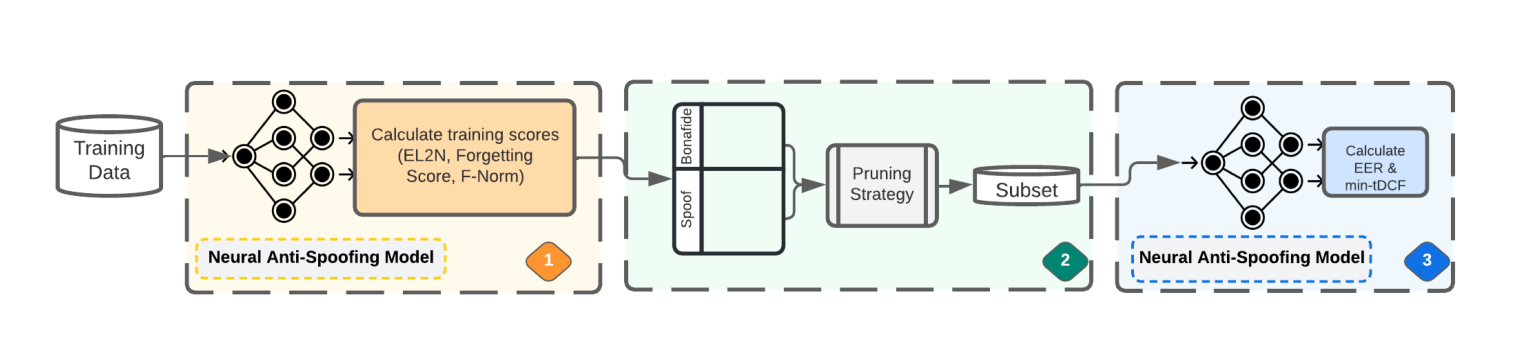
1. Train and record trajectories
An anti-spoofing model is trained on the complete ASVspoof dataset while per-example prediction errors are recorded at every epoch.
2. Measure rising normed error
Forgetting Norm sums positive epoch-to-epoch increases in EL2N. Examples whose classification becomes progressively harder receive larger scores.
3. Rank within each class
Spoof and bonafide examples are ranked separately so pruning preserves the original class ratio. The highest-scoring examples are retained.
4. Retrain on the subset
A fresh AASIST-L or RawNet2 model is trained on the selected subset and evaluated on the complete ASVspoof 2019 evaluation set.
Evaluation
Experiments use the ASVspoof 2019 Logical Access data with AASIST-L and RawNet2. Training data is pruned by 30%, 60%, and 90%; the full evaluation split is always retained.
Forgetting Norm is compared with Random selection, EL2N, and the discrete Forgetting Score. Pooled equal error rate and minimum tandem detection cost are reported across multiple runs.
| Model / pruning | Random EER | Forgetting Norm EER |
|---|---|---|
| AASIST-L / 30% | 9.27 | 6.62 |
| AASIST-L / 60% | 15.14 | 11.63 |
| RawNet2 / 30% | 14.68 | 9.85 |
| RawNet2 / 60% | 16.55 | 12.90 |
| RawNet2 / 90% | 18.38 | 16.02 |
Results
Forgetting Norm achieves the best pooled EER at every tested pruning fraction for both architectures. At 60% pruning with AASIST-L, it lowers EER from 15.14% under random pruning to 11.63%—a 23% relative improvement.
The improvement also holds across individual attack types. For attack A09, Forgetting Norm lowers EER from 1.20% to 0.41%, a paper-reported 65% relative gain.
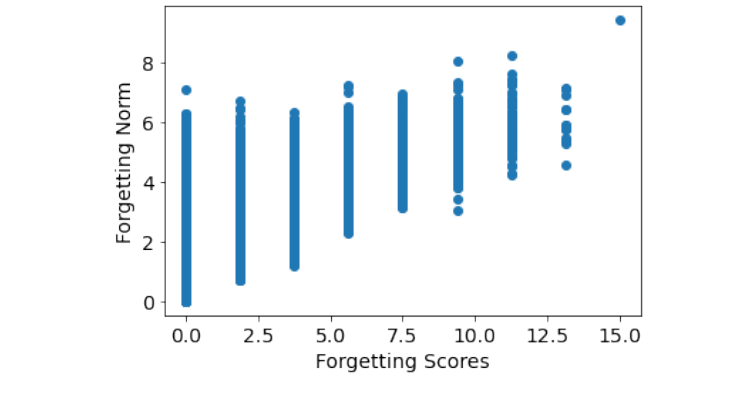
Granularity within the same forgetting count
Many examples share exactly the same discrete forgetting score, leaving no deterministic way to rank them. Their Forgetting Norm values vary widely, revealing different error trajectories and enabling more precise subset selection.
Conclusion
Forgetting Norm makes supervised dataset pruning more reliable for audio anti-spoofing. Its continuous training signal identifies informative examples that discrete forgetting counts cannot separate, improving both RawNet2 and AASIST-L under severe data constraints.
Citation
@inproceedings{azeemi22_interspeech,
  title     = {Dataset Pruning for Resource-constrained
               Spoofed Audio Detection},
  author    = {Azeemi, Abdul Hameed and Qazi, Ihsan Ayyub
               and Raza, Agha Ali},
  booktitle = {Interspeech},
  pages     = {416--420},
  year      = {2022}
}